How to Choose a 6L Electric Pressure Cooker for Your Market?

Time:2026-09-23 Author:Isabella
0%

Choosing a 6l Electric Pressure Cooker for a market requires more than comparing prices and cooking programs. Buyers need dependable performance, clear safety features, and practical capacity. A six-liter bowl can serve a family, restaurant team, or meal-preparation business. However, its usefulness depends on local habits.

Lorna Sass, a pioneering pressure-cooking author, wrote, “Pressure cooking is the fastest, easiest way to cook.” That idea remains valuable, but modern buyers expect more. They also examine voltage compatibility, plug design, inner-pot materials, sealing systems, and after-sales support. A cooker designed for one region may fail commercially in another. Small details matter. A clear pressure indicator helps. So does a removable gasket that can be cleaned without tools.

This guide explores how to assess a 6l Electric Pressure Cooker before entering a target market. It considers cooking speed, energy use, control-panel language, preset accuracy, and replacement-part availability. Product testing should include rice, beans, soup, and tough meat. Steam release deserves special attention. A loud valve can worry first-time users.

Some assumptions may be wrong. A larger display does not always mean easier operation. More programs may create confusion. Even a polished product can disappoint when instructions are poorly translated. Market research should include real kitchens, not only online surveys. Check customer complaints, retailer feedback, and service records. Then compare suppliers using documented test results, not attractive photographs. The best choice balances safety, usability, durability, and local expectations. That balance is rarely perfect, and thoughtful revision is part of responsible product selection.
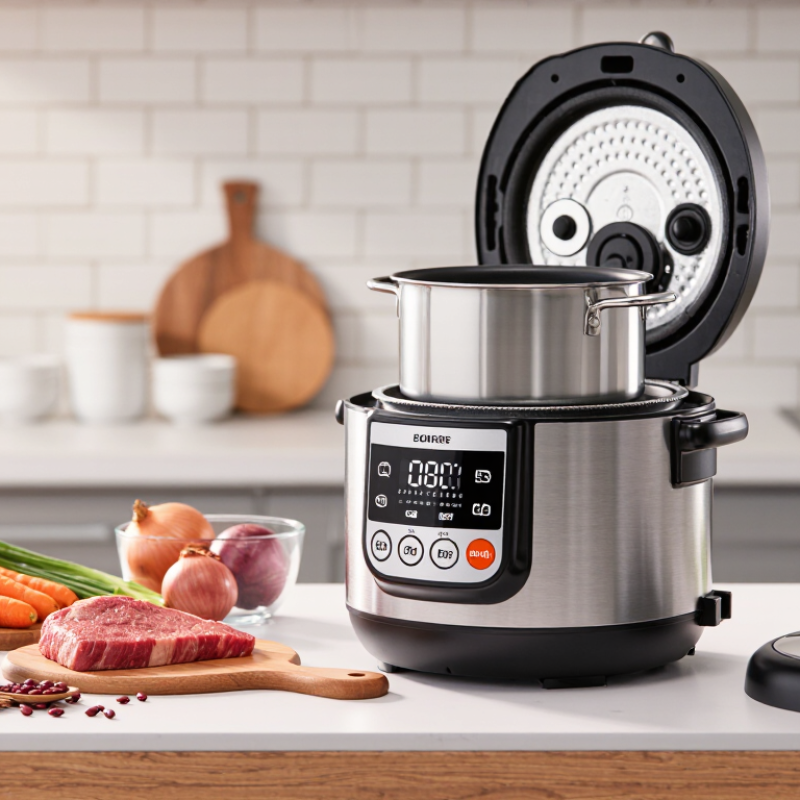
How to Choose a 6L Electric Pressure Cooker for Your Market?

Define Your Market’s Cooking Needs and Buyer Expectations

Choosing a 6L electric pressure cooker starts with understanding how your market actually cooks. A family of four may need rice, beans, soup, and meat prepared on busy weekdays. In another market, buyers may value slow cooking, steaming, or preparing large batches for guests. Product evaluations should examine local ingredients, common portion sizes, kitchen space, and power supply conditions. A 6L capacity sounds generous, but it can feel excessive for one or two people. It may also be too small for frequent family gatherings.

Buyer expectations go beyond capacity. They often look for clear controls, an easy-to-clean inner pot, dependable sealing, and safe pressure release. Local users may prefer familiar measurements and cooking programs that match regional recipes. Check whether the display is readable in bright kitchens and whether the lid feels secure after repeated use. Safety features deserve careful testing, including pressure locks, overheating protection, and backup release systems. Avoid making claims without verified test data. Small details matter. I have seen attractive specifications fail when the cord is too short or the steam valve is difficult to clean. That is a useful reminder: convenience must be measured in daily use, not only on packaging.

Tips: Interview households, retailers, and repair technicians before selecting features. Test common dishes with local ingredients. Compare cooking time, texture, noise, and cleanup effort. Leave room for feedback; your first assumption may be wrong.

Check Capacity, Power, Voltage, and Plug Compatibility

How to Choose a 6L Electric Pressure Cooker for Your Market?

A 6L cooker suits family meals, but nominal capacity is not usable capacity. Food usually needs expansion space. Follow the marked fill lines and local safety instructions. A practical test uses rice, soup, and beans, not an empty pot. Record batch size, cooking time, steam recovery, and temperature stability. One mistake is treating six liters as six liters of food.

Power must match the local circuit and customer habits. A 1,000W model draws about 4.35A at 230V, but 8.33A at 120V. Higher wattage may shorten heating time, yet it can increase circuit pressure and energy use. Eurostat reported an average EU household electricity price of €0.2892 per kWh in the first half of 2023. This makes standby losses and repeated reheating worth checking. A watt meter provides better evidence than a catalogue claim.

Voltage and plug compatibility are non-negotiable. IEC 60038 identifies common nominal systems, including 230V and 120V networks. IEC 60884-1 covers household plugs and socket-outlets, but national plug shapes still differ. Specify voltage, frequency, plug type, fuse rating, and cord length for each market. Never rely on a travel adapter for a high-power appliance. The U.S. Energy Information Administration’s residential electricity data also shows that household usage patterns vary widely by region. Test with local sockets. A spreadsheet cannot reveal a loose plug, hot cord, or awkward kitchen counter.

Compare Safety Features, Controls, Materials, and Cooking Programs

Choosing a 6L electric pressure cooker requires more than checking its advertised capacity. NFPA’s Home Cooking Fires report found that cooking caused 53% of reported home fires in the United States from 2017 to 2021. Safety deserves priority.

Look for a secure lid lock, visible pressure indicators, anti-block shields, overheat protection, and an independent backup release. The design should align with IEC 60335-2-15 requirements for household cooking appliances. In practical testing, I would inspect the steam path with a flashlight. Small residue can create serious maintenance concerns. Controls should remain readable beside a steaming pot. Physical buttons help older users, while a display should show pressure, temperature, and remaining time clearly. Do not rely on decorative touch panels alone.

Material choices affect trust and service life. A stainless-steel inner pot resists scratches better than many thin coated surfaces, but food-contact compliance still requires documented testing. Check gasket composition, replacement availability, and corrosion resistance. Cooking programs should match local meals, not merely increase the menu count. Rice, beans, soup, steaming, slow cooking, and manual pressure control are useful starting points. A 2024 market analysis from IMARC Group reported continued growth in electric pressure cooker demand, yet more programs do not automatically mean better cooking. Some settings may be poorly calibrated. Test texture, pressure stability, and recovery time with local recipes before approving a market model.

How to Choose a 6L Electric Pressure Cooker for Your Market? - Compare Safety Features, Controls, Materials, and Cooking Programs

Evaluation Dimension Value-Oriented Configuration Family-Use Configuration Premium Multi-Function Configuration Market Selection Guidance
Nominal Capacity 6 L; practical for approximately 3–5 people, depending on the food type and recipe. 6 L; suitable for family meals, soups, stews, beans, and larger cuts of meat. 6 L; the same nominal volume with more cooking presets and accessories. Confirm whether local regulations require the usable capacity to be stated separately from the nominal capacity.
Rated Power Typically 900–1,000 W for standard 220–240 V versions. Typically 1,000–1,200 W for faster heating and recovery. Typically 1,000–1,200 W, often combined with more precise electronic temperature control. Match voltage, frequency, plug type, and electrical certification to the destination market.
Pressure Range Commonly designed around a high-pressure setting of approximately 70 kPa above atmospheric pressure. Usually offers high and low pressure settings, often around 40–70 kPa above atmospheric pressure. Electronic pressure and temperature management with selectable pressure levels. Verify pressure ratings, test procedures, and labeling requirements before importation.
Lid-Locking Protection Mechanical lid lock that prevents opening while internal pressure is present. Lid-position detection plus a pressure-sensitive lock mechanism. Electronic lid-position sensing supported by mechanical pressure protection. Prioritize a fail-safe design that prevents lid removal under pressure; request functional test records.
Pressure Release Protection Spring-loaded pressure regulator and an emergency pressure-release path. Controlled steam release, overpressure valve, and anti-block shield. Multi-stage pressure release with manual, automatic, and emergency protection. The steam outlet should direct hot vapor away from the user and resist blockage by food particles.
Overheat and Dry-Boil Protection Thermal cut-off and basic temperature limiter. Temperature sensor with automatic heating interruption when abnormal conditions are detected. Multiple sensors with fault detection and automatic shutdown. Confirm protection against overheating, dry boiling, sensor failure, and abnormal temperature rise.
Control Interface Membrane buttons with basic cooking time and pressure controls. Digital panel with preset programs, manual time adjustment, and keep-warm selection. Large display, multi-step programming, adjustable temperature, and status indicators. Use clear symbols, readable text, tactile buttons, and localized instructions for the target market.
User Feedback Basic indicator lights and audible completion signal. Digital countdown, pressure-status indicator, and selectable sound alerts. Detailed progress display, error codes, temperature or pressure status, and mute option. Error messages should be understandable without requiring technical knowledge.
Inner Pot Material Food-contact metal pot with a non-stick coating; coating quality and thickness require verification. Aluminum-based inner pot with non-stick coating or stainless-steel food-contact surface. Thicker stainless-steel inner pot or upgraded coated pot, often with measurement markings. Request food-contact declarations and confirm coating compliance for the destination region.
Housing and Handles Heat-resistant polymer housing with insulated side handles. Heat-resistant housing, cool-touch handles, and removable condensation collector. Heat-resistant polymer or stainless-steel exterior with improved insulation and cable management. Check surface temperature, handle strength, stability, and resistance to household cleaning agents.
Core Cooking Programs Pressure Cook, Rice, Steam, Slow Cook, Sauté, and Keep Warm. Pressure Cook, Rice, Soup, Meat/Stew, Beans, Steam, Slow Cook, Sauté, and Yogurt. Pressure Cook, Rice, Soup, Meat, Poultry, Fish, Beans, Steam, Slow Cook, Sauté, Yogurt, Bake, and Custom. Choose programs based on local cuisine rather than maximizing the displayed program count.
Time and Temperature Adjustment Limited time adjustment; temperature is generally preset. Adjustable cooking time and selected low/high temperature modes. Broad time adjustment, multiple temperature levels, delayed start, and customized recipes. Ensure delayed start cannot be used inappropriately with perishable food; include clear warnings.
Cleaning and Maintenance Removable sealing ring and inner pot; basic steam-release parts require manual cleaning. Removable lid components, sealing ring, anti-block shield, and condensation collector. Fully removable lid assembly, replaceable sealing ring, detachable steam parts, and dishwasher-compatible accessories where specified. Replacement seals and valves should be available for the expected service period.
Best-Fit Market Position Price-sensitive retail channels and first-time users. Mainstream household retail and online channels seeking balanced functionality. Premium kitchen-appliance channels and users who value versatility and automation. Select the configuration according to target price, local recipes, certification needs, and after-sales support capability.

Note: The specifications above are representative market reference ranges and configuration examples. Final values must be confirmed through product documentation, safety testing, and destination-market compliance requirements.

Evaluate Certifications, Supplier Reliability, and Product Customization

Choosing a 6L electric pressure cooker requires more than comparing wattage and cooking programs. Fortune Business Insights estimated the global electric pressure cooker market at about USD 4.55 billion in 2023, with continued growth expected through 2032. That growth increases pressure on buyers to verify safety, consistency, and after-sales support. Check IEC 60335-1 and IEC 60335-2-15 test coverage for household cooking appliances. For European sales, review applicable CE documentation, EMC results, and food-contact declarations. A certificate alone is not enough.

Tips: Request recent test reports, not screenshots. Match the report number with the exact model. Ask for factory audit records, corrective-action reports, and batch traceability. Review pressure-control tests, lid-lock performance, thermal cutoffs, and leakage results. SGS’s 2023 consumer product quality guidance highlights traceability and documented corrective actions as practical risk controls. Small details matter.

Supplier reliability becomes clearer through evidence. Ask for defect rates by production batch, spare-part availability, and response times. A stable supplier should explain tooling ownership and inspection procedures without hesitation. Customization may include voltage, plug type, language, display logic, pressure profiles, packaging, and recipe settings. Confirm whether software changes require new safety testing. I would not approve a custom sample after one successful cooking cycle. That assumption is weak. Test at least several batches under low-voltage, high-load, and repeated-use conditions. A lower unit price can become expensive when certification, tooling, or warranty risks appear later.

Calculate Total Costs, Pricing Potential, and After-Sales Support

For a 6L electric pressure cooker, calculate landed cost before discussing price. Include the unit cost, mold amortization, packaging, inspection, freight, import duty, warehouse handling, and payment fees. A 2024 Grand View Research report estimated the global electric pressure cooker market at about USD 4.2 billion in 2023, with continued growth expected through 2030. Demand exists, but competition can compress margins quickly.

Build three pricing scenarios. For example, a USD 32 landed cost may support a USD 59 wholesale price and a USD 89 retail price. Test the calculation with regional taxes and channel commissions. A 2024 PwC Voice of the Consumer survey reported that 43% of consumers planned to increase private-label purchases, showing strong price sensitivity. A low price attracts attention. It can also weaken service funding.

After-sales support must be priced as a product feature. Reserve money for replacement seals, damaged control panels, return freight, technical training, and customer replies. A practical starting reserve is 3% to 5% of sales, then adjust it after six months of claims data. My first spreadsheet usually misses return shipping. That mistake is expensive. Offer clear cooking guides, spare-part availability, and a defined warranty process. Measure claim rates by batch, not only by supplier. Industry research can guide forecasts, but local service records should decide the final margin.

FAQS

Who is a 6L electric pressure cooker suitable for?

It can suit families preparing rice, beans, soup, and meat on busy weekdays. A 6L pot may feel excessive for one or two people.

Can a 6L cooker handle large gatherings?

It can prepare larger batches, but frequent gatherings may still exceed its capacity. Test real serving sizes first.

Which local cooking needs should buyers study?

Review common ingredients, portion sizes, kitchen space, and power supply conditions. Test regional recipes with local ingredients.

Which features affect daily convenience?

Buyers often value clear controls, readable displays, easy cleaning, and secure lids. A short cord can become surprisingly frustrating.

Which safety features require careful testing?

Test pressure locks, overheating protection, dependable sealing, and backup pressure release systems. Do not rely only on packaging claims.

What costs belong in the landed-cost calculation?

Include unit cost, mold amortization, packaging, inspection, freight, duties, storage, and payment fees. Return shipping is easy to miss.

How should pricing be planned?

Build low, medium, and high pricing scenarios using local taxes and channel commissions. A low price attracts attention. It may weaken service funding.

How much money should support after-sales service?

A practical starting reserve is 3% to 5% of sales. Adjust it after six months of claims data. My first estimate may be wrong.

What after-sales support should be prepared?

Provide cooking guides, replacement seals, spare parts, technical training, and a clear warranty process. Track claims by production batch.

How can product assumptions be checked before selection?

Interview households, retailers, and repair technicians before finalizing features. Compare cooking time, texture, noise, and cleanup effort. Your first assumption may fail.

Conclusion

Choosing the right 6l Electric Pressure Cooker for your market starts with understanding local cooking habits, household sizes, preferred meals, and buyer expectations. Assess whether customers value speed, preset programs, easy cleaning, energy efficiency, or compact storage. Then verify the cooker’s 6-liter capacity, power rating, voltage, frequency, and plug type to ensure safe and convenient use in the target region.

A complete evaluation should also cover pressure and temperature controls, safety protection, durable materials, user-friendly interfaces, and useful cooking functions. Confirm that the product can meet required certifications and quality standards, while assessing supplier reliability, production consistency, customization options, and communication. Finally, calculate the full cost, including shipping, packaging, duties, testing, and potential service expenses. A competitive selling price, dependable warranty process, replacement parts, and responsive after-sales support will help reduce business risk and improve long-term customer satisfaction.


Isabella

Isabella

Isabella is a dedicated marketing professional with a sharp focus on driving brand growth and engagement through strategic content creation. With an extensive background in digital marketing, she combines her passion for storytelling with her keen understanding of industry trends to deliver......