China Top Extra Large Pressure Cooker Manufacturer?

Time:2026-10-25 Author:Henry
0%

Choosing the China Top Extra Large Pressure Cooker Manufacturer requires more than comparing catalog prices. Capacity, pressure stability, material quality, and after-sales support all influence commercial performance. A large stainless-steel cooker may serve restaurants, catering kitchens, food processors, and institutional buyers. However, oversized equipment creates greater demands on sealing, heat distribution, handles, and safety controls.

Dr. Elizabeth Andress, a recognized food-safety expert, states, “Pressure canning is the only recommended method for canning low-acid foods.” Her guidance highlights an important point: pressure equipment requires controlled procedures, not casual assumptions. Manufacturers should therefore explain pressure ratings, testing methods, compatible heating sources, and operating instructions. Buyers should also request material certificates, inspection records, sample testing, and evidence of consistent production.

Look closely at the factory.

A dependable Extra Large Pressure Cooker manufacturer should demonstrate practical engineering experience. Its factory should show pressure testing equipment, clean welding lines, calibrated gauges, and traceable quality checks. Product customization also matters. Commercial users may need unusual capacities, reinforced lids, adjustable valves, or replacement sealing rings.

The “top” supplier is not always the cheapest. It is the supplier that communicates clearly and corrects problems quickly. Some product pages make impressive claims without enough technical evidence. That deserves reflection. A careful buyer should verify every important detail before placing a large order.

This guide examines leading Chinese manufacturers through product design, manufacturing capability, safety documentation, customization, export experience, and customer support. The goal is practical comparison. Real kitchens need reliable equipment, not attractive promises.
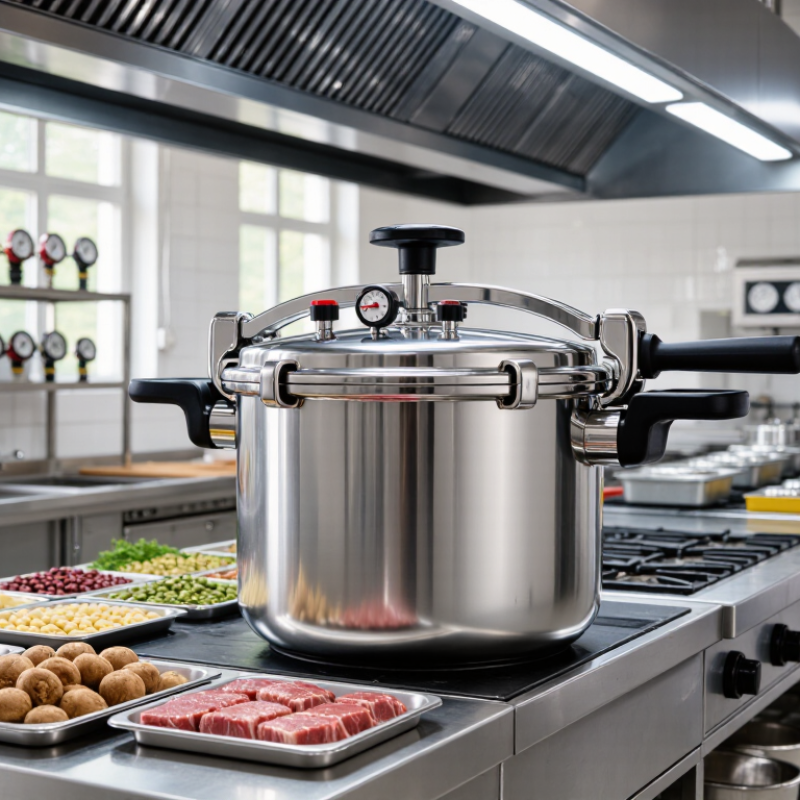
China Top Extra Large Pressure Cooker Manufacturer?

What Defines a Top Extra Large Pressure Cooker Manufacturer in China?

What Defines a Top Extra Large Pressure Cooker Manufacturer in China?

A top extra large pressure cooker manufacturer combines engineering discipline with practical factory experience. Grand View Research valued the global pressure cooker market at about USD 4.2 billion in 2023. Its report also expects steady growth through 2030. This demand increases pressure on Chinese manufacturers to deliver safer, larger vessels. For commercial models, capacity alone is not enough. A reliable factory should explain wall thickness, pressure ratings, gasket life, and safety-valve performance clearly. Stainless steel grades must be verified through material certificates, not only sales claims.

Production control reveals real expertise. Look for laser-weld inspection, pressure testing, dimensional checks, and batch traceability. EN 12778 and applicable Chinese standards provide useful reference points for pressure cookers. Independent laboratory reports should confirm each safety function. For a 20-litre cooker, inspectors should check lid locking, steam release, and handle strength under repeated use. Small details matter. A loose handle becomes a serious problem quickly.

The best manufacturers also provide pilot samples before mass production. They record test temperatures, holding times, and failure results. ISO 9001 certification supports process control, but it does not replace product testing. No factory is perfect. Some still depend too heavily on manual inspection. That weakness deserves honest discussion and correction. Buyers should request inspection records, food-contact material evidence, and corrective-action reports before approving large orders.

Core Features of Extra Large Pressure Cookers

China Top Extra Large Pressure Cooker Manufacturer?

Core Features of Extra Large Pressure Cookers

Extra large pressure cookers serve restaurants, catering kitchens, and high-volume households. Their real advantage is controlled batch cooking, not simply a larger pot. A 10-litre vessel may not safely hold 10 litres during pressure cooking. Manufacturers should mark the maximum fill line clearly, especially for beans, grains, and foaming soups.

Reliable pressure control is essential. The U.S. Department of Energy reports that pressure cooking can reduce cooking time and energy use compared with conventional methods. That benefit depends on stable sealing, accurate sensors, and efficient heat transfer. Important features include a locking lid, steam-release control, an overpressure valve, and a backup safety system. IEC 60335-2-15 also provides relevant safety requirements for appliances that heat liquids.

Material selection affects service life. Food-contact stainless steel, reinforced handles, and a replaceable sealing ring support repeated commercial use. A thick base helps reduce hot spots on gas or induction surfaces. I would not judge quality by weight alone. Heavy construction can improve stability, but it may also slow handling and increase cleaning effort. Some large models still lack comfortable grip design. That detail deserves more attention.

For buyers, test recovery time after adding cold ingredients. Check pressure stability, gasket access, drainage, and readable markings. Independent laboratory testing and documented inspection records provide stronger evidence than capacity claims alone.

China Top Extra Large Pressure Cooker Manufacturer? - Core Features of Extra Large Pressure Cookers

Specification Dimension Typical Range or Requirement Core Feature Practical Benefit
Nominal Capacity 10–40 L for extra-large household, catering, and light-commercial models Large-volume cooking chamber Supports batch cooking of beans, meat, soup, stock, vegetables, and preserved foods.
Usable Fill Level Generally limited to two-thirds of the pot; about half-full for foods that expand or foam Expansion and foam clearance Leaves space for pressure generation and helps reduce the risk of blocked vents or excessive foaming.
Construction Material Food-contact stainless steel, commonly 18/8 or 18/10 grades; aluminum is also used in some models Corrosion-resistant cooking vessel Stainless steel offers durability, easier cleaning, and compatibility with many food-service environments.
Operating Pressure Common pressure-cooking settings are approximately 50–80 kPa above atmospheric pressure, depending on the design Regulated pressure control Raises the boiling temperature of water and shortens cooking time compared with open-pot cooking.
Approximate Cooking Temperature Approximately 110–120°C at typical pressure-cooking settings High-temperature steam environment Helps tenderize tough cuts and accelerate the cooking of grains, legumes, and dense foods.
Lid Locking System Mechanical locking lid with a pressure-dependent interlock Lock prevents opening under pressure Improves operator safety by preventing the lid from being removed before pressure is released.
Primary Pressure-Release Valve Adjustable regulator, weighted valve, or spring-controlled valve Maintains the selected pressure Provides consistent cooking performance when the cooker is used according to its instructions.
Backup Safety Protection Secondary pressure-release path, overpressure plug, or safety valve Redundant pressure protection Provides an additional safeguard if the primary regulator becomes obstructed or cannot regulate normally.
Gasket or Sealing Ring Heat-resistant, food-contact elastomer designed for periodic replacement Airtight lid seal Reduces steam loss and supports stable pressure during the cooking cycle.
Heating Compatibility Model-dependent: gas, electric coil, ceramic, or induction-compatible base Broad cooktop compatibility Allows selection according to the available kitchen equipment and energy source.
Base Design Reinforced or encapsulated base; flat base preferred for stable contact Improved heat distribution and stability Helps reduce hot spots and improves handling of a heavy, full cooker.
Handling Design Two heat-resistant side handles and a secure lid handle Balanced lifting and transport Makes a large, heavy vessel easier to move when empty or partially filled.
Cleaning Requirements Removable gasket, washable lid components, and accessible pressure channels Serviceable pressure system Simplifies routine cleaning and inspection, which is especially important in high-use kitchens.
Typical Applications Institutional kitchens, restaurants, catering operations, food preparation, and large households High-volume batch cooking Reduces cooking cycles and supports consistent preparation of large quantities.
Selection Criteria Capacity, usable fill limit, pressure rating, material, heat-source compatibility, safety devices, and spare-part availability Application-matched specification Helps buyers choose a cooker that matches workload, kitchen infrastructure, and maintenance practices.

Note: Specifications vary by model and applicable safety requirements. Always follow the product manual, maximum-fill markings, inspection instructions, and local regulations.

Manufacturing Standards and Quality Control in China

China Top Extra Large Pressure Cooker Manufacturer?

A reliable Chinese manufacturer should treat safety as a process, not a marketing phrase. Production begins with approved stainless steel, traceable heat numbers, and documented material certificates. Engineers should verify wall thickness, lid structure, gasket fit, and pressure ratings before cutting metal. For extra large cookers, load distribution matters. A heavy lid can expose weak hinges or uneven seals.

Quality control continues through welding and assembly. Skilled inspectors check weld penetration, surface finish, and possible cracks around handles. Each pressure vessel should receive leak testing and controlled pressure testing. Safety valves, gauges, locking systems, and release mechanisms require individual inspection. Factory records should connect every unit with its batch, operator, test result, and inspection date. Sampling alone may be insufficient for critical safety parts.

Manufacturing should follow applicable Chinese standards and the destination market’s requirements. An experienced supplier can provide test reports, inspection procedures, calibration records, and independent verification when needed. Still, no factory is perfect. A clean document cannot replace an on-site audit. I would inspect storage areas, observe a real pressure test, and question rejected-unit handling. Small details matter. A scratched sealing surface today may become a serious problem after repeated heating cycles. Better manufacturers welcome difficult questions, because practical reliability is built through evidence, not promises.

How to Evaluate a Chinese Pressure Cooker Supplier

China Top Extra Large Pressure Cooker Manufacturer?

How to Evaluate a Chinese Pressure Cooker Supplier

The global pressure cooker market was valued at about USD 5.15 billion in 2023, according to Fortune Business Insights. Its forecast growth increases sourcing pressure. Large-capacity products require stronger control over metal thickness, sealing, and safety testing.

Ask for the factory’s quality certificates, inspection records, and production capacity. ISO 9001 shows a controlled quality system, but it does not prove product safety alone. Request material certificates for stainless steel and check whether each batch has traceability. A reliable supplier should explain pressure testing, valve testing, and leak testing in measurable terms.

See the factory if possible. Check welding areas, calibration labels, storage conditions, and finished-product sampling. A supplier producing extra-large cookers should provide drawings, tolerance limits, and test reports for the exact model. Generic certificates are weak evidence.

Test samples independently.

The American Society for Quality reports that poor quality can cost companies 15% to 20% of sales. That figure is not a universal rule, but it shows why cheap quotations deserve careful review. Compare five samples, not one. Inspect the lid after repeated heating cycles, because a perfect first sample may hide inconsistent production. This is where many evaluations become uncomfortable: delivery promises are easy, while repeatable safety evidence is harder.

Applications and Customization Options for Large Pressure Cookers

China Top Extra Large Pressure Cooker Manufacturer?

Applications and Customization Options for Large Pressure Cookers

Large pressure cookers support restaurants, institutional kitchens, food processors, and catering facilities. They prepare beans, meat, soups, grains, and sterilized ingredients in controlled batches. Grand View Research valued the global pressure cooker market at about USD 5 billion in 2023, with steady growth expected through 2030. This trend reflects demand for faster cooking and lower kitchen labor.

Capacity is only one design decision. Commercial users may need 50, 100, or 200 liters, depending on daily output. Custom options include stainless-steel grades, jacketed heating, tilting bodies, locking lids, pressure gauges, and automated temperature controls. A reinforced frame helps when the vessel is moved across wet floors. Rounded internal corners also simplify cleaning and reduce residue buildup.

Safety needs practical verification. Pressure relief devices, calibrated gauges, interlocks, and documented testing should match applicable regulations. ASME Boiler and Pressure Vessel Code principles are often used when designing pressurized equipment. Mordor Intelligence identifies automation and energy efficiency as important developments in commercial food equipment. However, larger capacity does not always mean better efficiency. Poor insulation can waste heat, while oversized vessels may increase water and cooking time. Field testing matters more than a brochure. Sometimes, the “custom” design needs another review.

Large Pressure Cooker Operating Guide: Pressure vs. Steam Temperature

Saturated-steam temperatures commonly used when configuring large pressure cookers for food processing, sterilization, and industrial cooking.

The chart uses approximate saturated-steam values at sea level. Higher operating pressure increases steam temperature, while vessel capacity, heating method, safety valves, materials, controls, and basket or agitator design can be customized for different applications.

FAQS

What makes a reliable extra large pressure cooker manufacturer?

It combines engineering knowledge with practical factory experience. It explains pressure ratings, wall thickness, gasket life, and valve performance clearly.

Which quality checks should buyers request?

Ask for weld inspections, pressure tests, dimensional checks, and batch traceability. Each cooker should have records linked to its production batch.

What safety features matter in a 20-liter pressure cooker?

Inspect the lid lock, steam release system, pressure gauge, relief device, and handle strength. Small weaknesses can become serious during repeated use.

Should stainless steel claims be independently verified?

Yes. Request material certificates for food-contact surfaces. Sales descriptions alone are not enough.

Can manufacturers provide samples before mass production?

A capable factory should provide pilot samples. Testing should record temperatures, holding times, pressure results, and any failure findings.

What customization options are available for large commercial cookers?

Options may include 50, 100, or 200-liter capacities, jacketed heating, tilting bodies, locking lids, and automatic temperature controls.

How can a large cooker support easier cleaning?

Rounded internal corners reduce residue buildup. Smooth stainless surfaces also make washing more practical in busy kitchens.

Does a larger capacity always improve efficiency?

Not always. Poor insulation can waste heat, while oversized vessels may use more water and cooking time.

What documentation should buyers review before ordering?

Review inspection records, food-contact material evidence, safety test reports, and corrective-action records. The paperwork may reveal weaknesses.

Are certifications enough to prove product quality?

No. Certification supports process control, but it cannot replace product testing. Manual inspection may still miss problems.

Conclusion

A top Extra Large Pressure Cooker manufacturer in China is defined by more than production capacity. It should combine reliable engineering, durable materials, precise pressure control, secure locking systems, efficient heating performance, and user-friendly operation. Strong manufacturers maintain consistent quality through careful material selection, standardized production processes, strict inspections, pressure testing, and traceable quality control at every stage.

When evaluating a Chinese pressure cooker supplier, buyers should consider manufacturing experience, production capability, certifications, testing procedures, customization support, and communication efficiency. Extra large pressure cookers can serve commercial kitchens, food-processing facilities, catering operations, and other high-volume cooking environments. Depending on application needs, manufacturers may offer different capacities, body materials, heating methods, safety configurations, control systems, and surface finishes. A dependable supplier should also provide clear technical specifications, sampling services, packaging options, and after-sales support, helping customers select a safe, efficient, and practical solution for large-scale cooking requirements.


Henry

Henry

Henry is a dedicated marketing professional with a profound expertise in the company's offerings. With years of experience in the industry, he possesses an impressive understanding of the market dynamics and consumer behaviors that drive success. Henry is committed to sharing his insights through......